Scone Loft / Card box / Jam or cream first?
Know-howJam or cream first on a scone?
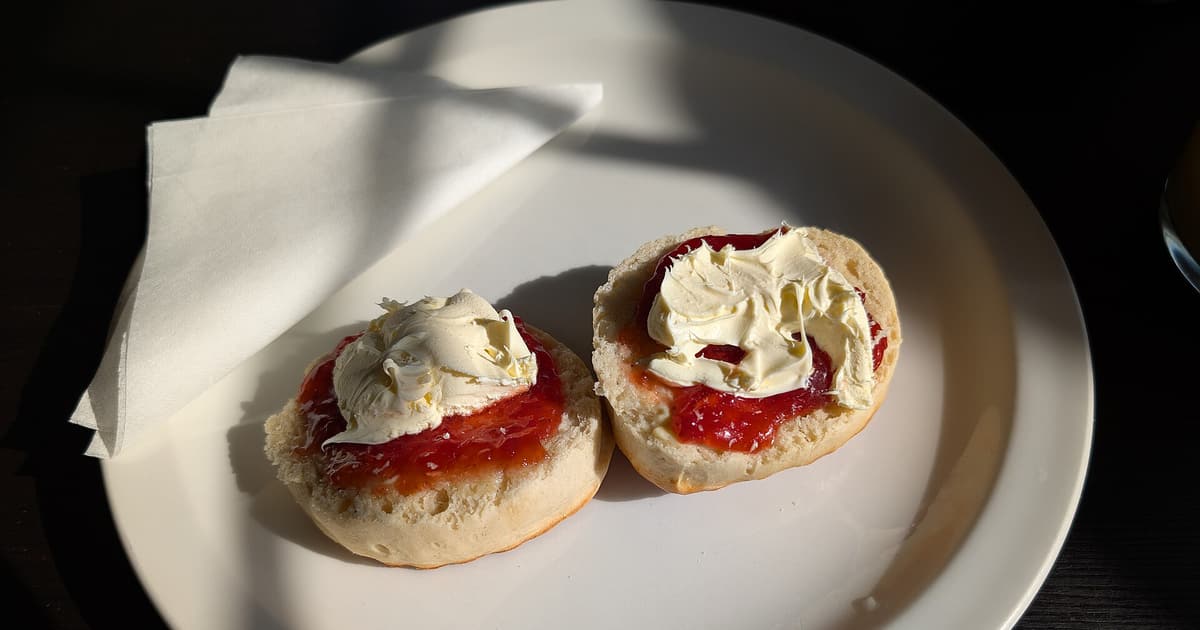

Cream first in Devon, jam first in Cornwall. That is the convention, and if you are eating in one of those counties it costs nothing to go along with it. Everywhere else, do whichever you prefer, because nothing beyond local pride hangs on it.
The reason this argument has lasted so long is that it costs nothing and can never be settled. Visit South Devon, a body with an obvious interest, describes the debate as a long-running friendly division between West Country neighbours, and says plainly that it believes in cream first. Most of what follows on the subject online is cheerful repetition. The facts are shorter.
What each county actually does
The Devon method treats clotted cream as you would butter. You spread it onto the cut scone, then spoon jam on top. The cream acts as a seal, and it is easy to get a generous, even layer.
The Cornish method spreads jam first, so it soaks a little into the warm crumb, then sits a spoonful of cream on top. You see the cream, the jam stays where you put it, and you can use rather less of both.
What the law does and does not protect
Here the argument has an actual document behind it, though not the one people imagine. GOV.UK's register of protected food names lists Cornish Clotted Cream with Protected Designation of Origin status, originally registered with the EU on 1 October 1998 and carried into the UK scheme on 31 December 2020.
The product specification is a good read if you like this sort of thing. It requires milk produced in Cornwall and cream with a minimum butterfat content of 55%. The cream is scalded to between 70 and 80C, without boiling, for at least an hour, while a thick crust forms, then cooled to no more than 5C so that the crust hardens and the cream under it thickens. The specification describes a nutty flavour and a colour from cream to golden yellow, and adds that the product is "spread rather than poured".
What it does not do is say anything about the order of toppings, beyond noting that the cream is best known as an accompaniment to scones and jam. So Devon-made clotted cream is still clotted cream, and it just cannot be sold as Cornish. And a Cornish cream tea served cream first breaks no law at all, only a few hearts.
Why Cornwall made so much of it
The specification gives a practical reason for all this. Clotting was a way of preserving milk: small herds on Cornish farms produced a lot of rich milk in spring and summer, and heating and skimming the cream extended the life of something that would otherwise spoil. It also quotes an average butterfat of 4.33% for Cornish milk against 4.1% for England and Wales, and credits the deep colour to carotene in the grass. Those figures come from the document itself, and it is not new, so read them as the producers' case and not as current data. Distribution to London and elsewhere began, it says, after visitors tasted it on holiday.
Where the cream tea comes from
Devon claims the idea. The Visit South Devon account traces it to Tavistock Abbey, where monks are said to have fed workers on bread and "clowted cream" after a Viking raid in the late 10th century. It is a lovely story from a tourism body, and it should be read as one. The same account is careful to point out what could not have been on that bread: no strawberry jam, because sugar had not reached England, and no tea, which came in the 17th century.
It also concedes that scones are not Devon's invention, describing them as a Scottish griddled bread that became the modern oven-baked scone once baking powder arrived in the 19th century. Before scones took over, the same account says, cream and jam went on small yeast buns under various local names. Cream teas as a named tea-room offering date, on its telling, from the tourism boom after the 1850s.
Cornwall's specification takes its own line, noting that clotted cream has been made there for generations and appears in 17th-century writing. It also passes along a claim from "some historians" about Phoenician tin traders, in language that keeps it at arm's length. We will do the same.
Which order is better to eat?
This part is opinion, so take it as that. Warm scones favour jam first: cream melts on contact, and it slides off a hot surface, whereas jam gives it something to grip. A scone that has cooled completely is friendlier to the Devon way, because cold clotted cream spreads like soft butter without collapsing. Thick cream handles either. Thin or whipped cream behaves badly under jam and is one more reason to look for proper clotted cream if you can.
A sharper jam is also worth having, because clotted cream is very rich. Strawberry is the convention and the Cornish specification mentions it by name, but raspberry or blackcurrant both cut through the fat well.

Serving a cream tea at home
- Bake the scones the same morning. Our plain scone recipe makes eight, and the troubleshooting card is there if they come out flat.
- Split them by hand rather than with a knife, which keeps the rough crumb that holds the jam.
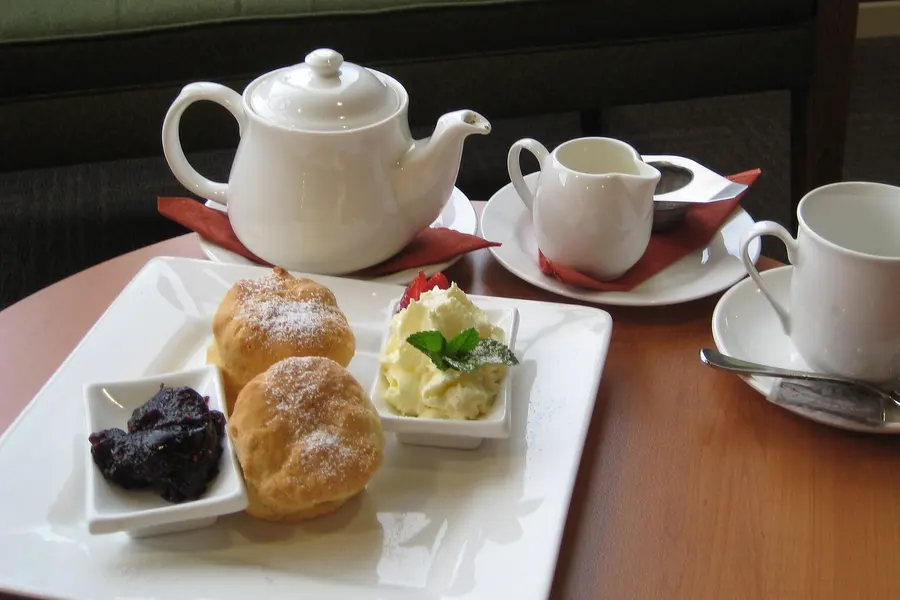
- Serve the cream and jam in separate bowls with their own spoons, then let people settle the matter for themselves.
- Keep the clotted cream in the fridge until just before serving. The Food Standards Agency says your fridge should run between 0 and 5C and that chilled food should be out for the shortest time possible during preparation, four hours at most. A summer table in full sun will take its toll well before that.
For something less contested on the same table, a Victoria sandwich is the traditional partner, though it has an argument of its own about whether cream belongs in the middle.
Sources opened for this card
- GOV.UK protected food name register: Cornish Clotted Cream
- Defra: Cornish Clotted Cream product specification (PDF)
- Visit South Devon: the history of the cream tea
- Food Standards Agency: how to chill, freeze and defrost food safely
Links checked November 2026. General information only; follow official food safety advice for your household.